


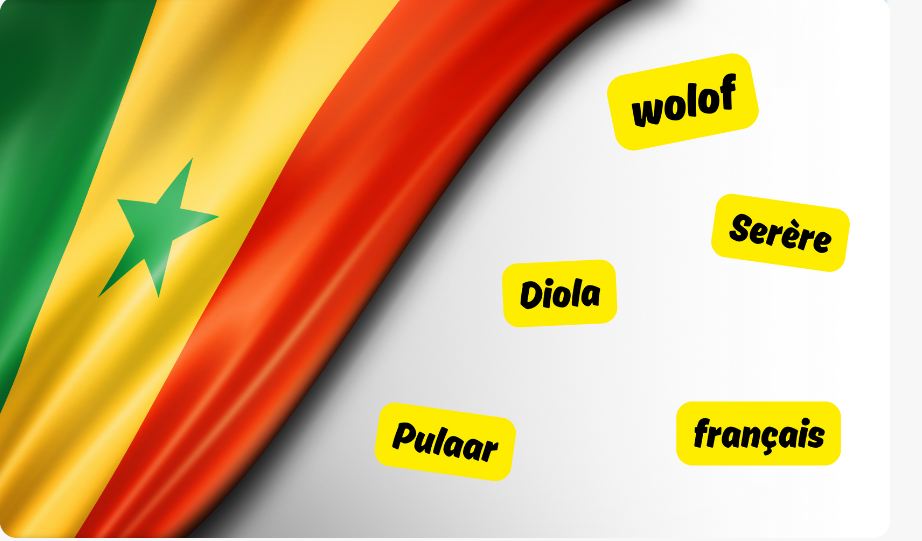
Senegal is a country located along the Atlantic coast of West Africa that is home to 18.9 million people. Like many other francophone African countries, it is characterised by linguistic and cultural diversity, connected by the French language. Despite the significant influence of French, Senegal thrives thanks to the smart mix of French and local languages.
Whether you are enjoying a chat in French in Dakar or learning Jola phrases at a market in Casamance, you will discover that in Senegal, language is both a bridge and a celebration of the country dynamic identity and culture.
French: The Official Language
French is the official language of Senegal. Under Article 1 of the Constitution, it is designated as the country’s official language. De facto, it is the medium of government, legal affairs, formal education and official business. It is widely used in hotels, government departments, university lecture halls, and courtrooms. Government documents, legal contracts and major newspapers all rely heavily on France’s linguistic legacy in Senegal.
South African tourists will find that French is extremely useful for navigating major cities such as Dakar, Thiès and Saint-Louis. From checking into hotels to seeking medical care or arranging transport, French will generally get you through with ease.
Wolof: The language of the Streets
However, if you want to experience the true essence of Senegal, you should familiarise yourself with the Wolof language. Although it does not have official status, it is the real lingua franca, bringing people together across the capital and much of western and central Senegal. You are most likely to hear lively conversations in Wolof in public places such as markets, at the back of city buses, and in Senegalese homes.
Most Senegalese people switch between French and Wolof with remarkable fluidity, even mid-sentence. Fluency in both French and Wolof is an integral part of daily life and a sign of cultural agility, bridging generations and social circles.

National and Local Languages of Senegal
According to the Senegalese Constitution, there are six national languages: Wolof, Pulaar, Serer, Jola, Mandinka and Soninke. Each is more than a means of communication; it represents specific regions and cultures.
- Pulaar: Spoken primarily in the north and east, especially around Matam, Podor, and Bakel, this language echoes through Peul communities scattered nationwide.
- Serer: Well-rooted in the Sine region’s villages such as Fatick and Niakhar, Serer maintains a proud legacy.
- Jola: Dip down to Casamance—around Ziguinchor, Oussouye, or Elinkine—and you’ll find communities speaking Jola daily.
- Mandinka and Soninke: These languages thrive in the south-east and in border regions where multiple identities converge.
What’s important for any visitor or curious South African linguists to remember is that, in smaller towns and villages, these languages are not just tourist attractions – they provide a way to experience warm, authentic encounters. If you ask your host which language they prefer, they will always respond with a smile, and they will always appreciate it if you try to connect with them in French or Wolof.
Foreign Languages usage in Senegal
Beyond Senegal’s own linguistic diversity, foreign languages are also present, most notably English. In international hotels in Dakar and popular resort destinations such as Saly and Cap Skirring, English is widely spoken, particularly among younger staff, guides and individuals with international connections.
However, French remains your surest bet for most everyday tasks outside these areas. You may also hear Spanish, Italian, German or Dutch here and there, but don’t rely on these languages for deep conversation or practical affairs.
Tips for South African travellers
- When in doubt, begin with a friendly greeting in Wolof—something as simple as “Salam aleikum” speaks volumes about respect.
- Quickly follow up with, “Do you speak French?” or “Do you speak English?” adapting as you go.
- In tourist centres, a bit of English may work, but in rural or remote regions, come prepared with basic French phrases, a written itinerary, and phone navigation.
Fast French translation and Senegal Visa Service by Frenchside
Frenchside offers fast French translation services. We also specialise in a fast and reliable Senegal visa service, ensuring your application is accurate and complete with a turnaround time of around five working days.
We provide an expedited translation and Senegal visa service for business, tourism or family visits, ensuring that your documents will be completed quickly and efficiently.
Contact us today to experience our expert assistance and reliable services first-hand.
Email: info@frenchside.co.za
Tel : + 27 12 348 3134
Cell/Whatssap: + 27 81 347 6060